Eating at a restaurant is one of the easiest places to start using Spanish in real life. A few useful words can help you get a table, understand the menu, order what you want, ask questions about your meal, and pay without switching immediately to English.
Restaurant Spanish is also highly repetitive. Once you recognize phrases such as ¿Qué va a pedir?, ¿Algo más?, and La cuenta, por favor, you will hear them again and again in restaurants, cafés, and local food spots throughout Mexico.
Here is a quick starting point:
| English | Spanish |
| A table for two, please | Una mesa para dos, por favor |
| The menu, please | El menú, por favor |
| What do you recommend? | ¿Qué me recomienda? |
| I would like… | Quisiera… |
| What is in this dish? | ¿Qué lleva este platillo? |
| Not spicy, please | Sin picante, por favor |
| The check, please | La cuenta, por favor |
| Can I pay by card? | ¿Puedo pagar con tarjeta? |
Essential Spanish Restaurant Vocabulary
You do not need to memorize every food item before eating out in Spanish. Start with the words that help you understand how a restaurant works and what the server is asking.
Some of the most useful restaurant words include:
- el restaurante: restaurant
- la mesa: table
- el menú / la carta: menu
- el mesero / la mesera: waiter / waitress
- el platillo: dish
- la comida: food or meal
- la bebida: drink
- el pedido: order
- la cuenta: check or bill
- la propina: tip
- el efectivo: cash
- la tarjeta: card
In Mexico, mesero and mesera are commonly used for restaurant servers. In Spain, you are more likely to hear camarero or camarera. Regional differences like these are one reason focusing on Mexican Spanish can make everyday conversations easier during a stay in Mexico.
How To Read A Restaurant Menu In Spanish
Restaurant menus become much easier once you recognize a few repeating categories. You can often understand the structure of the menu even when some individual ingredients are unfamiliar.
Common sections include:
| Spanish | English |
| Entradas | Appetizers / starters |
| Sopas | Soups |
| Ensaladas | Salads |
| Plato fuerte | Main course |
| Guarniciones | Side dishes |
| Bebidas | Drinks |
| Postres | Desserts |
| Especialidad de la casa | House specialty |
| Plato del día | Dish of the day |
Menú Vs. Carta
Both menú and carta can refer to what a restaurant offers, but their exact use varies between countries and restaurants.
La carta often refers to the complete list of individually priced dishes. Menú can mean the restaurant menu generally, but it may also refer to a fixed combination of courses offered for one price.
In Mexico, you may also see comida corrida, especially in smaller local restaurants or fondas. This usually refers to an affordable set lunch that can include several courses.
How To Ask For A Table
Your restaurant conversation may begin before you even see a menu.
For a simple request, say:
Una mesa para dos, por favor.
A table for two, please.
Other helpful phrases include:
¿Tienen una mesa disponible?
Do you have a table available?
Tenemos una reservación a nombre de Ana.
We have a reservation under the name Ana.
¿Podemos sentarnos afuera?
Can we sit outside?
The host may respond with ¿Cuántas personas? for “How many people?” or ¿Adentro o afuera? for “Inside or outside?”
How To Ask About The Menu
Once seated, you may want recommendations instead of trying to understand every item yourself.
Try:
¿Qué me recomienda?
What do you recommend?
¿Cuál es la especialidad de la casa?
What is the house specialty?
¿Cuál es el plato del día?
What is the dish of the day?
¿Qué lleva este platillo?
What is in this dish?
That final question is particularly useful in Mexico because many dishes include several ingredients, sauces, garnishes, or preparations that may not be obvious from the name.
How To Order Food In Spanish
There are several natural ways to order without needing a complicated sentence.
Polite Ways To Order
Quisiera los tacos de pescado, por favor.
I would like the fish tacos, please.
Para mí, la sopa, por favor.
For me, the soup, please.
Me gustaría una ensalada.
I would like a salad.
Voy a pedir el pollo.
I am going to order the chicken.
You may hear both pedir and ordenar when talking about ordering food. Pedir literally means to ask for or request and is useful in many situations beyond restaurants.
What The Server May Ask You
Knowing what to say is only half of restaurant Spanish. You also need to recognize common questions coming back to you.
A server might say:
¿Qué les traigo de tomar?
What can I bring you to drink?
¿Ya decidieron?
Have you decided?
¿Qué van a pedir?
What are you going to order?
¿Algo más?
Anything else?
¿Todo bien?
Is everything okay?
¿Desean postre?
Would you like dessert?
You do not have to understand every word. Listening for familiar terms such as tomar, pedir, postre, and algo más can often tell you what the server needs.
How To Ask About Ingredients And Make Changes
Restaurant Spanish becomes especially useful when you need to change an order.
You can say:
Sin cebolla, por favor.
Without onion, please.
Con la salsa aparte, por favor.
With the sauce on the side, please.
¿Puede hacerlo sin queso?
Can you make it without cheese?
Poco picante, por favor.
Only a little spicy, please.
¿Esto lleva chile?
Does this contain chili?
Food is one of the many situations where knowing local vocabulary matters. If you are spending time in the Riviera Maya, AKO’s Playa del Carmen guide gives additional context for everyday life in the city beyond the classroom.
Food Allergies And Dietary Needs In Spanish
If you have an allergy, communicate it clearly rather than relying only on a phrase such as “I don’t like” an ingredient.
Useful expressions include:
Soy alérgico / alérgica a los cacahuates.
I am allergic to peanuts.
Tengo alergia a los mariscos.
I have a shellfish allergy.
No puedo comer gluten.
I cannot eat gluten.
Soy vegetariano / vegetariana.
I am vegetarian.
Soy vegano / vegana.
I am vegan.
¿Tienen opciones vegetarianas?
Do you have vegetarian options?
For a serious allergy, make sure the server understands the specific ingredient you must avoid.
What To Say When You Do Not Understand
Real conversations move faster than language exercises. Asking someone to repeat themselves is completely normal.
Try:
¿Puede repetir, por favor?
Can you repeat that, please?
¿Puede hablar más despacio?
Can you speak more slowly?
No entendí.
I didn’t understand.
¿Qué significa esto?
What does this mean?
Being able to keep a conversation going is often more valuable than knowing every word perfectly.
How To Ask For The Check In Spanish
When you are ready to leave, the most important phrase is simple:
La cuenta, por favor.
The check, please.
You can also say:
¿Me trae la cuenta, por favor?
Can you bring me the check, please?
In Mexico, servers generally will not assume you want the bill simply because you have finished eating, so asking for la cuenta is an important phrase to know.
How To Pay At A Restaurant In Spanish
Payment creates another short conversation that is worth preparing for.
¿Puedo pagar con tarjeta?
Can I pay by card?
Voy a pagar en efectivo.
I am going to pay in cash.
¿Aceptan tarjeta de crédito?
Do you accept credit cards?
¿Podemos pagar por separado?
Can we pay separately?
Useful payment vocabulary includes efectivo for cash, tarjeta de crédito for credit card, tarjeta de débito for debit card, cambio for change, and propina for tip.
You may also hear:
¿Juntos o por separado?
Together or separately?
A Simple Restaurant Conversation In Mexico
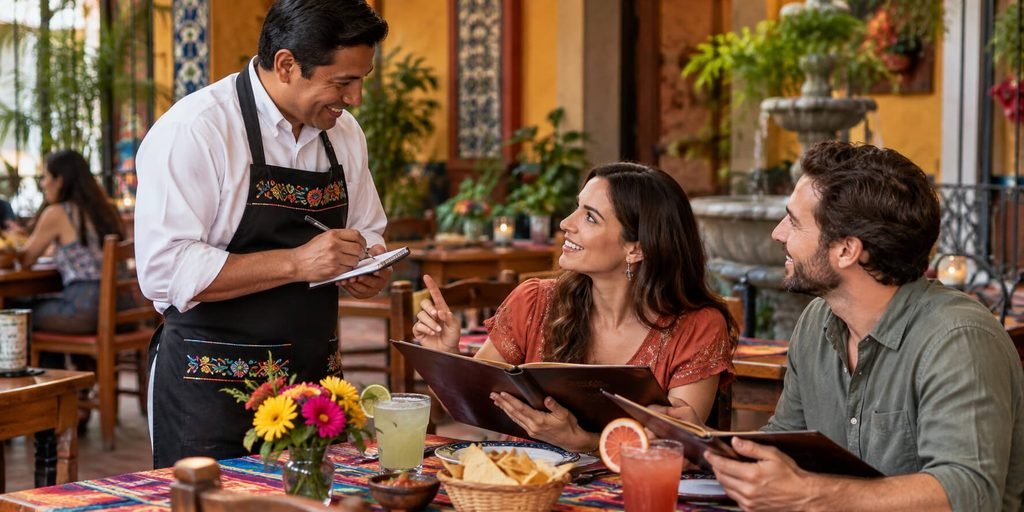
Here is how these phrases can come together naturally.
Mesero: Buenas tardes. ¿Cuántas personas?
Good afternoon. How many people?
Cliente: Dos, por favor.
Two, please.
Mesero: ¿Qué les traigo de tomar?
What can I bring you to drink?
Cliente: Dos aguas, por favor. ¿Qué nos recomienda para comer?
Two waters, please. What do you recommend for food?
Mesero: Los tacos de pescado son muy populares.
The fish tacos are very popular.
Cliente: Perfecto. Para mí, los tacos, pero sin cebolla, por favor.
Perfect. The tacos for me, but without onion, please.
Later:
Cliente: Disculpe, ¿nos trae la cuenta, por favor?
Excuse me, can you bring us the check, please?
Cliente: ¿Puedo pagar con tarjeta?
Can I pay by card?
That is already enough Spanish to manage a complete restaurant visit.
Practice Restaurant Spanish In Playa Del Carmen
Vocabulary becomes much easier to remember when you connect it to a real experience. Ordering breakfast, asking about ingredients, buying coffee, or speaking with a restaurant server gives you repeated opportunities to use the same practical Spanish.
AKO Language School focuses on communication that adult learners can actually use in daily life. Its Spanish learning approach combines native teachers, personalized instruction, speaking practice, and cultural context in Playa del Carmen.
Students who are not currently in Mexico can build the same practical skills through online Spanish lessons with native teachers, including vocabulary for travel, food, everyday conversations, and living in Mexico.
The goal is not to memorize a restaurant dictionary. It is to have enough Spanish to sit down, order what you want, understand the response, and enjoy the conversation around your meal.
Frequently Asked Questions
How Do You Politely Order Food In Spanish?
Quisiera…, Me gustaría…, and Para mí… are useful ways to order politely. Adding por favor makes the request sound courteous and natural.
What Is The Difference Between Menú And Carta?
Usage varies, but la carta often means the full list of individually priced dishes. Menú can refer to the menu generally or to a set meal with several courses for one price.
How Do You Ask What Is In A Dish?
Say ¿Qué lleva este platillo? This is a useful way to ask which ingredients or components are included in a dish.
How Do You Say “Not Spicy” In Spanish?
Say Sin picante, por favor. If you want some heat but not too much, you can say Poco picante, por favor.
How Do You Ask For The Check In Spanish?
The simplest phrase is La cuenta, por favor. You can also say ¿Me trae la cuenta, por favor?
How Do You Ask To Pay By Card?
Say ¿Puedo pagar con tarjeta? To ask whether the restaurant accepts cards before ordering, use ¿Aceptan tarjeta?
What Does “Para Llevar” Mean?
Para llevar means “to go” or “takeaway.” For example, Quiero dos tacos para llevar means “I want two tacos to go.”
What Does Propina Mean?
Propina means tip or gratuity. You may use phrases such as ¿Está incluida la propina? to ask whether the tip is already included.